You have a limited time to bring a claim after a delivery vehicle crash, and how long depends on who owned the vehicle. Washington generally allows three years. A Postal Service vehicle can cut that to two. Call before the deadline decides the question for you.

Finding the Policy That Pays After a Seattle Delivery Crash

Brain Injury Law of Seattle represents people hurt by delivery vans, box trucks, and app delivery drivers across Seattle, King County, and Snohomish County. These collisions look ordinary and are not. The company that owns the vehicle, the company that employs the driver, the insurance behind both, and even the claim deadline can change depending on whose logo is on the door. Our Seattle car accident attorneys identify the right defendant and the right policy first, then document the brain injury a routine scan missed.

Why Injured Clients Trust Brain Injury Law of Seattle

Delivery crashes rarely come with a clear answer about who is responsible or which insurer stands behind the vehicle. Add a brain injury that a routine scan overlooks, and the stakes climb higher still. Brain Injury Law of Seattle built its practice around exactly this kind of complexity, so clients get answers instead of more questions during an already difficult time.

  • Brain injury is the practice, not a practice area: Traumatic and catastrophic brain injury is the center of everything we do.
  • 25 years and more than 100 jury trials: Founding attorney Scott Blair has concentrated on brain injury for 25 years, has tried more than 100 jury trials to verdict, and chairs the American Association for Justice Traumatic Brain Injury Litigation Group.
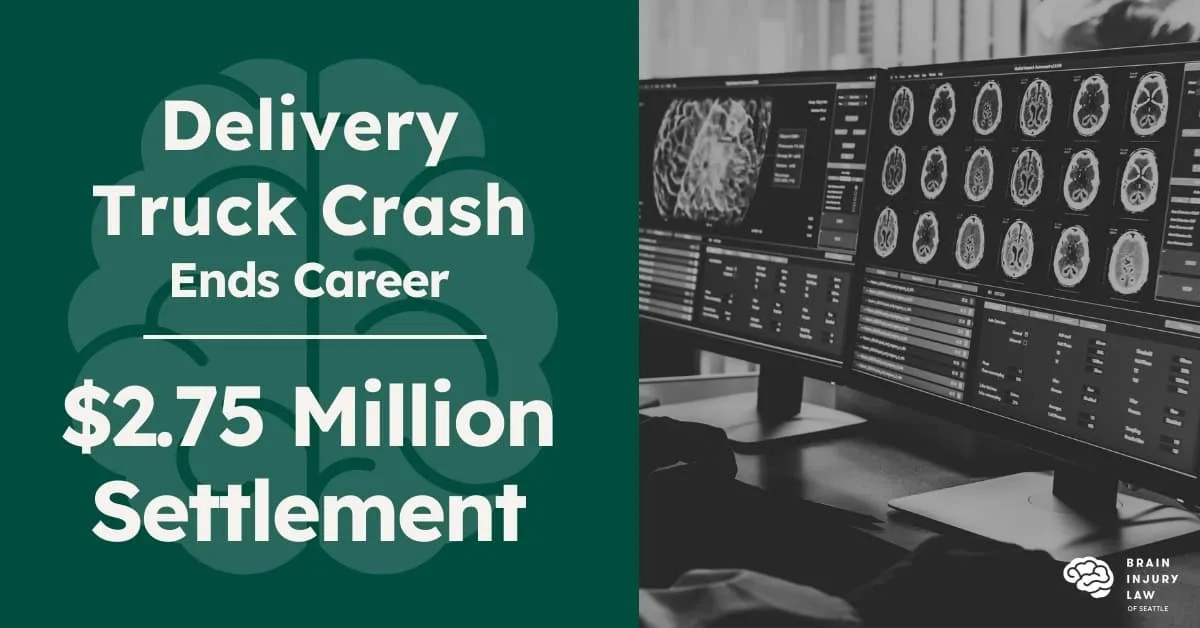
  • Imaging that shows what a standard scan misses: We apply advanced neuroimaging to document brain injuries that a routine CT or MRI often misses.
  • A medical team, not only a legal one: We work with neurologists, rehabilitation specialists, sleep doctors, endocrinologists, and cognitive therapists.
  • We come to you: When travel is difficult, we meet clients at home, and se habla español.
  • No fee unless we recover: Case evaluations are free, and you pay no attorneys’ fees until we recover for you.

Hiring an attorney after a serious crash is rarely something anyone has practice doing, especially while managing pain, medical appointments, and financial pressure. Clients choose Brain Injury Law of Seattle because that unfamiliar process becomes manageable, not because they were promised a specific outcome. What follows is a relationship built on the same standard, case after case.

The Vehicle That Hit You Decides What Claim You Have

Delivery is not one industry, and the insurance behind the vehicle depends on which of these it was:

  • A national carrier’s company fleet: With a UPS or FedEx driver in a company vehicle, the claim is aimed at the company and its commercial coverage rather than at a personal auto policy.
  • A contracted delivery service: Amazon-branded vans are frequently operated by separate businesses under contract, so the van carries one name while the employer, and the policy, belong to another.
  • A gig driver in a personal car: Someone delivering meals or groceries through an app is usually driving a personal vehicle covered by a personal auto policy.
  • A United States Postal Service vehicle: A mail truck crash can be governed by the federal tort claims procedure instead of an insurance claim, which changes both the process and the deadline.

Naming the correct companies early is not a formality. It decides how much insurance exists and which deadline is already running. Our Seattle personal injury attorneys start there.

A Mail Truck Crash Can Run on a Federal Clock

A collision with a Postal Service vehicle is often handled differently from other Washington crashes. Under 39 U.S.C. §409(c), the tort claims provisions of Title 28 of the United States Code apply to tort claims arising out of Postal Service activities, which can route the case through a federal administrative process instead of an insurance claim. Three timing rules follow, and they are easy to miss.

Under 28 U.S.C. §2401(b), the claim is forever barred unless it is presented in writing to the appropriate federal agency within two years after it accrues. The same section bars it unless suit is begun within six months after the agency mails written notice of final denial by certified or registered mail. Under 28 U.S.C. §2675(a), no action may be instituted until the agency has finally denied the claim in writing, and if the agency does not finally dispose of it within six months of filing, the claimant may choose to treat that delay as a denial.

Notice the shape of that. Two years is the window to present a written claim, not to file a lawsuit, and Washington’s ordinary three-year period is not the clock that governs.

The App Driver May Carry Only the State Minimum

Washington regulates rideshare insurance closely, and injured people reasonably assume the same protection follows food and package delivery. Often it does not. The state’s commercial transportation services coverage requirements attach to a provider that uses a digital network to connect passengers to drivers for a prearranged ride.

A delivery-only platform never matches a passenger to a car, so it does not fit that definition and the rideshare limits are not required of its drivers. When a driver was logged in to a company that carries passengers and delivers food on the same network, the answer turns on log-in status and is genuinely unsettled. We research that rather than guess.

What can remain is the ordinary state floor. Under RCW 46.30.020(1)(a), a driver has to be insured under a liability policy meeting the limits in RCW 46.29.090, or satisfy the requirement through self-insurance, a certificate of deposit, or a liability bond. Those limits are at least:

  • $25,000 for bodily injury to or death of one person in any one accident
  • $50,000 for two or more people
  • $10,000 for property damage

These figures are the minimums, not what a given driver carries, and $25,000 does not begin to answer a brain injury. That chapter also does not govern vehicles registered with the Washington Utilities and Transportation Commission as common or contract carriers.

The gap can be wider still. The Washington Office of the Insurance Commissioner warns that most personal auto policies sold in this state do not cover losses during gig work, and that many say so outright. That makes your underinsured motorist coverage, and the company standing behind the driver, central rather than incidental.

The Head Injury a Delivery Crash Can Hide

Delivery vans and box trucks are heavier and taller than the cars they strike, and the impact often arrives from an angle no one saw, such as a van pulling out of a double-parked position, backing down a driveway, or turning across a bike lane. The head does not have to hit anything for the brain to be hurt.

Symptoms do not always announce themselves at the scene. The Centers for Disease Control and Prevention explains that some concussion symptoms may appear right away while others may not appear for hours or days, and that the resulting problems may be overlooked by the injured person, family members, or the healthcare provider.

A normal CT or MRI does not rule out a brain injury. If the hospital said your scans looked fine and you are still losing words, sleeping badly, or unable to follow a conversation, that distance between how you look and how you function is the injury. Our guide to brain injury symptoms explains what to watch for, and our Seattle catastrophic injury lawyers build the proof an insurer has to answer.

Washington generally allows three years to bring a personal injury action under RCW 4.16.080(2). Evidence disappears long before the deadline does.

Schedule a Free Consultation With a Seattle Delivery Vehicle Accident Lawyer

If a delivery van, box truck, mail truck, or app driver hurt you in the Seattle area, you do not have to work out which company or which deadline applies before you call. Contact us for a free case evaluation. You pay no attorney fees until we recover for you, we can meet you at home when travel is hard, and se habla español.

Frequently Asked Questions

Who pays if an Amazon-branded van hits me in Seattle?

That depends on who employed the driver. Many Amazon-branded vans are operated by separate businesses under contract rather than by Amazon directly, so the logo does not identify the insurer. Establishing which companies were involved, and locating every policy behind them, is among the first things we do.

How long do I have to bring a claim after a delivery vehicle crash?

Washington generally requires a personal injury action to be commenced within three years under RCW 4.16.080(2). A crash involving a United States Postal Service vehicle can be different. A tort claim against the United States has to be presented in writing to the appropriate federal agency within two years after it accrues, and suit then has to be begun within six months after the agency mails a final denial. Confirm your deadline with a lawyer rather than assuming one applies.

What if the driver was using a personal car for a delivery app?

Then the required insurance may be nothing more than Washington’s minimum liability limits, which start at $25,000 for one injured person. Washington’s commercial transportation services coverage requirements attach to platforms that connect passengers to drivers for a prearranged ride, so a delivery-only app does not trigger the larger rideshare limits. Your underinsured motorist coverage may matter a great deal.
Delivery Vehicle Accidents
You have a limited time to bring a claim after a delivery vehicle crash, and how long depends on who owned the vehicle. Washington generally allows three years. A Postal Service vehicle can cut that to two. Call before the deadline decides the question for you.

Finding the Policy That Pays After a Seattle Delivery Crash

Brain Injury Law of Seattle represents people hurt by delivery vans, box trucks, and app delivery drivers across Seattle, King County, and Snohomish County. These collisions look ordinary and are not. The company that owns the vehicle, the company that employs the driver, the insurance behind both, and even the claim deadline can change depending on whose logo is on the door. Our Seattle car accident attorneys identify the right defendant and the right policy first, then document the brain injury a routine scan missed.

Why Injured Clients Trust Brain Injury Law of Seattle

Delivery crashes rarely come with a clear answer about who is responsible or which insurer stands behind the vehicle. Add a brain injury that a routine scan overlooks, and the stakes climb higher still. Brain Injury Law of Seattle built its practice around exactly this kind of complexity, so clients get answers instead of more questions during an already difficult time.

  • Brain injury is the practice, not a practice area: Traumatic and catastrophic brain injury is the center of everything we do.
  • 25 years and more than 100 jury trials: Founding attorney Scott Blair has concentrated on brain injury for 25 years, has tried more than 100 jury trials to verdict, and chairs the American Association for Justice Traumatic Brain Injury Litigation Group.
  • Imaging that shows what a standard scan misses: We apply advanced neuroimaging to document brain injuries that a routine CT or MRI often misses.
  • A medical team, not only a legal one: We work with neurologists, rehabilitation specialists, sleep doctors, endocrinologists, and cognitive therapists.
  • We come to you: When travel is difficult, we meet clients at home, and se habla español.
  • No fee unless we recover: Case evaluations are free, and you pay no attorneys’ fees until we recover for you.

Hiring an attorney after a serious crash is rarely something anyone has practice doing, especially while managing pain, medical appointments, and financial pressure. Clients choose Brain Injury Law of Seattle because that unfamiliar process becomes manageable, not because they were promised a specific outcome. What follows is a relationship built on the same standard, case after case.

The Vehicle That Hit You Decides What Claim You Have

Delivery is not one industry, and the insurance behind the vehicle depends on which of these it was:

  • A national carrier’s company fleet: With a UPS or FedEx driver in a company vehicle, the claim is aimed at the company and its commercial coverage rather than at a personal auto policy.
  • A contracted delivery service: Amazon-branded vans are frequently operated by separate businesses under contract, so the van carries one name while the employer, and the policy, belong to another.
  • A gig driver in a personal car: Someone delivering meals or groceries through an app is usually driving a personal vehicle covered by a personal auto policy.
  • A United States Postal Service vehicle: A mail truck crash can be governed by the federal tort claims procedure instead of an insurance claim, which changes both the process and the deadline.

Naming the correct companies early is not a formality. It decides how much insurance exists and which deadline is already running. Our Seattle personal injury attorneys start there.

A Mail Truck Crash Can Run on a Federal Clock

A collision with a Postal Service vehicle is often handled differently from other Washington crashes. Under 39 U.S.C. §409(c), the tort claims provisions of Title 28 of the United States Code apply to tort claims arising out of Postal Service activities, which can route the case through a federal administrative process instead of an insurance claim. Three timing rules follow, and they are easy to miss.

Under 28 U.S.C. §2401(b), the claim is forever barred unless it is presented in writing to the appropriate federal agency within two years after it accrues. The same section bars it unless suit is begun within six months after the agency mails written notice of final denial by certified or registered mail. Under 28 U.S.C. §2675(a), no action may be instituted until the agency has finally denied the claim in writing, and if the agency does not finally dispose of it within six months of filing, the claimant may choose to treat that delay as a denial.

Notice the shape of that. Two years is the window to present a written claim, not to file a lawsuit, and Washington’s ordinary three-year period is not the clock that governs.

The App Driver May Carry Only the State Minimum

Washington regulates rideshare insurance closely, and injured people reasonably assume the same protection follows food and package delivery. Often it does not. The state’s commercial transportation services coverage requirements attach to a provider that uses a digital network to connect passengers to drivers for a prearranged ride.

A delivery-only platform never matches a passenger to a car, so it does not fit that definition and the rideshare limits are not required of its drivers. When a driver was logged in to a company that carries passengers and delivers food on the same network, the answer turns on log-in status and is genuinely unsettled. We research that rather than guess.

What can remain is the ordinary state floor. Under RCW 46.30.020(1)(a), a driver has to be insured under a liability policy meeting the limits in RCW 46.29.090, or satisfy the requirement through self-insurance, a certificate of deposit, or a liability bond. Those limits are at least:

  • $25,000 for bodily injury to or death of one person in any one accident
  • $50,000 for two or more people
  • $10,000 for property damage

These figures are the minimums, not what a given driver carries, and $25,000 does not begin to answer a brain injury. That chapter also does not govern vehicles registered with the Washington Utilities and Transportation Commission as common or contract carriers.

The gap can be wider still. The Washington Office of the Insurance Commissioner warns that most personal auto policies sold in this state do not cover losses during gig work, and that many say so outright. That makes your underinsured motorist coverage, and the company standing behind the driver, central rather than incidental.

The Head Injury a Delivery Crash Can Hide

Delivery vans and box trucks are heavier and taller than the cars they strike, and the impact often arrives from an angle no one saw, such as a van pulling out of a double-parked position, backing down a driveway, or turning across a bike lane. The head does not have to hit anything for the brain to be hurt.

Symptoms do not always announce themselves at the scene. The Centers for Disease Control and Prevention explains that some concussion symptoms may appear right away while others may not appear for hours or days, and that the resulting problems may be overlooked by the injured person, family members, or the healthcare provider.

A normal CT or MRI does not rule out a brain injury. If the hospital said your scans looked fine and you are still losing words, sleeping badly, or unable to follow a conversation, that distance between how you look and how you function is the injury. Our guide to brain injury symptoms explains what to watch for, and our Seattle catastrophic injury lawyers build the proof an insurer has to answer.

Washington generally allows three years to bring a personal injury action under RCW 4.16.080(2). Evidence disappears long before the deadline does.

Schedule a Free Consultation With a Seattle Delivery Vehicle Accident Lawyer

If a delivery van, box truck, mail truck, or app driver hurt you in the Seattle area, you do not have to work out which company or which deadline applies before you call. Contact us for a free case evaluation. You pay no attorney fees until we recover for you, we can meet you at home when travel is hard, and se habla español.

Frequently Asked Questions

Who pays if an Amazon-branded van hits me in Seattle?

That depends on who employed the driver. Many Amazon-branded vans are operated by separate businesses under contract rather than by Amazon directly, so the logo does not identify the insurer. Establishing which companies were involved, and locating every policy behind them, is among the first things we do.

How long do I have to bring a claim after a delivery vehicle crash?

Washington generally requires a personal injury action to be commenced within three years under RCW 4.16.080(2). A crash involving a United States Postal Service vehicle can be different. A tort claim against the United States has to be presented in writing to the appropriate federal agency within two years after it accrues, and suit then has to be begun within six months after the agency mails a final denial. Confirm your deadline with a lawyer rather than assuming one applies.

What if the driver was using a personal car for a delivery app?

Then the required insurance may be nothing more than Washington’s minimum liability limits, which start at $25,000 for one injured person. Washington’s commercial transportation services coverage requirements attach to platforms that connect passengers to drivers for a prearranged ride, so a delivery-only app does not trigger the larger rideshare limits. Your underinsured motorist coverage may matter a great deal.