Our client Malvika Bhatia had retained another law firm to help her for her brain injury she received as a result of being run over by a bus. While this law firm did a fine job with injury claims, Malvika wanted a firm that specialized in brain injury cases. She started diligently searching all firms in the Seattle area that handled brain injury cases. Before getting to BILS, she had interviewed 5 other attorneys who do brain injury work in the Seattle area. Three of the five she met with and discussed her case with told her that she made too much money in her job at Microsoft to recover much, and that a dance video that she made after being run over by a bus would also cause the value of her case to plummet, as it suggested she was not that hurt. For this reason, all three other law firms told her they would recommend that she settle her case for less than $1,000,000. She knew that the value of what was taken from her by the bus company that ran her over and caused a brain injury was worth more than that.
Then she came to BILS. We listened to her and immediately recognized the power of her story, how she had been affected in her job, her private life, and the extent to which the taking of her healthy brain from her had affected her. We knew the value of her case was far higher than what she had been told by others and believed in her story.
It all started on February 9, 2017, when she was walking to catch the Microsoft bus in downtown Seattle to get to work in Redmond. As she walked up to the intersection of 2nd and Cedar, she noticed a school bus owned by First Student Inc. pulling up to the crosswalk and stop while she stood stopped as well. When the bus stopped, she started crossing the street, and the bus driver accelerated into her, and she was dragged under the bus and dragged for 30 feet as it turned right onto 2nd Ave. A video from inside the bus registered her terrorized screams, but the bus driver did not even know he had hit her-his dispatch radio and the music inside the bus he was playing distracted him. Other pedestrians finally flagged the bus driver down and he stopped.
She was taken to Harborview hospital where she was diagnosed with a host of orthopedic injuries from being run over by the bus, including a fractured spine and shoulder injuries, as well as a brain injury with post traumatic headaches, and PTSD from the terrifying ordeal.
Prior to this injury, Malvika was working at Microsoft as an engineer, and had been selected into a program for future leaders at Microsoft, a program reserved for the top 1-2% of employees. Because of her intelligence and drive, she had been promoted every year at a pace that was faster than virtually every other new college hire. Her career track was on a very promising trajectory that would have taken her into leadership positions at Microsoft providing very strong compensation and stock options. She was also in peak physical shape and competed in pole dancing exercises locally. She did physical maneuvers akin to those seen by cirque du solei performers in Las Vegas. Dancing was her love, and she was determined to get back to that despite all her injuries with the bus. Two days out of the hospital, she wrote a Facebook post talking about how she was going to be back in no time and was confident she would heal from all this quickly. This post would later be used by the defense against her trying to deny the extent of her eventual injuries.
Despite her optimism, her physical injuries and her brain injury made it especially tough for her to meet her projected path of recovery. She was not able to work much and was finally referred by her brain injury rehab doctor to an intensive brain injury rehab program. 5 months after the incident, she finally was able to start back to work. At the same time, she was working very hard on her physical injuries because all she wanted to do was to get back to dancing. By November of 2017 she had worked incredibly hard to prove to herself she could still dance and entered a pole fitness competition. The videotape shows her trying hard to perform at her prior level of excellence, but it was obvious she had lost some of her abilities. At the end of her performance, those in the audience who knew about her attempt to make it back from her injuries all stood and gave her an emotional round of applause.
Unfortunately, the bus company felt this just proved that she was totally fine if she could dance like this, overlooking the competitor spirit that pushed her to get back to dancing. After proving this to herself, she knew her physical injuries would not permit her to keep doing this, so she never competed again.
At work she also had a hard time keeping up with her prior pace, and it was not long before her supervisor at Microsoft was pushing her to get back to her former self after being off work for 5 months. She did just that and pushed herself to get back to her old self that could multitask, work 12-14 hours a day, remember everything she did, and be on point in high level meetings. But with a brain injury, this took a toll on her. When she pushed herself to do more, her post traumatic headaches and migraines got worse, and she was forced to take another 9 months off work to rehab from the headaches. By the time she got back to work again, her prior position had been given away, and she had to find another position without the upward growth she had before. She continued to have ongoing fatigue and concentration problems, and would come home from work worn out and needing to sleep for 2 hours to do anything in the evening. She had a broad circle of friends who were equally driven and smart like her who saw the stark change in her cognitive abilities before and after being run over. A prior supervisor also testified for her from Microsoft, who described her as one of the best prospects within the division they both worked in for future leadership. After the brain injury, he described her as not up to her prior intellectual capabilities, fatiguing quickly and to being able to stare at screens for long. Because of this, she was taken out of the future leader program, losing her ability to advance to leadership positions.
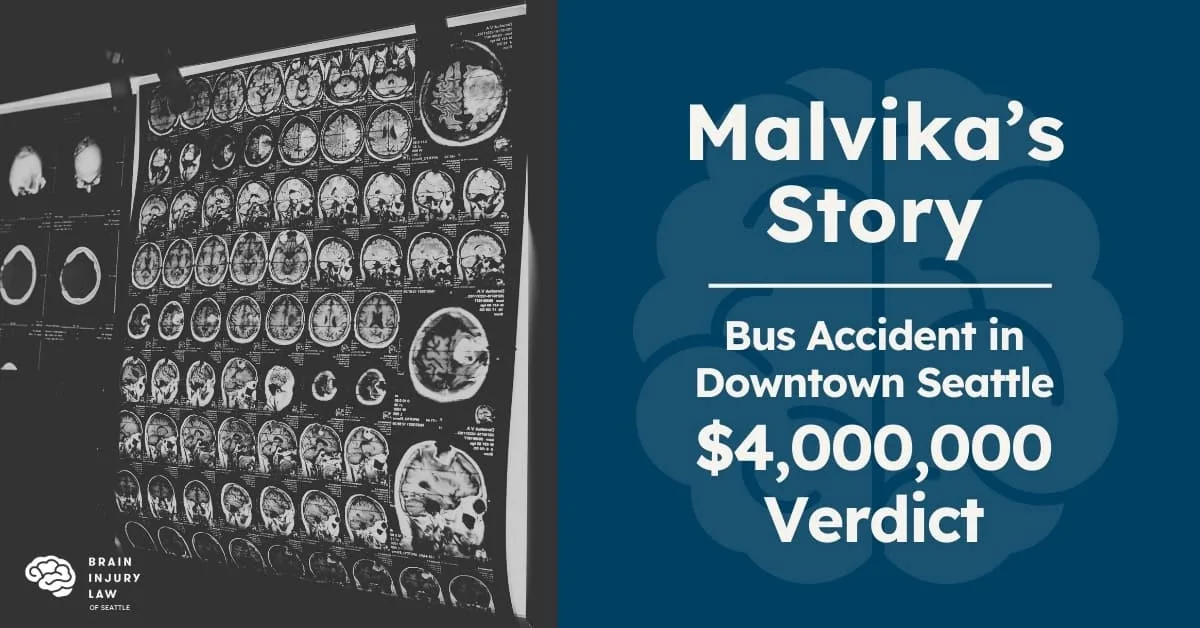
Finally, Malvika suffered from ongoing PTSD as a result of being run over and dragged by the defendant’s bus. She worked hard to get past the effects of PTSD, but they were always there. BILS took the case, obtained the objective MRI evidence to document brain injuries, and retained some of the leading experts in the field to evaluate her records and condition. They all agreed she had a brain injury and was limited by the brain injury despite the fact she was still working in a cognitively demanding job.
All of this was presented to First Student, and First Student denied liability, suggesting instead that Malvika ran in front of the bus-despite two independent eyewitnesses supporting her story. First Student also denied there was even a brain injury, but if there was, it was minor in nature and would have resolved within weeks. As for the physical injuries, First Student admitted to the fractured spine being related, but said most of her other physical problems were pre-existing and not related to the bus incident. It blamed her PTSD on things other than being run over by a bus. First Student relied on a series of defense experts who regularly worked for First Student in such cases. As a result, their offer to resolve the case at mediation was $25,000. Malvika wanted justice from 12 jurors rather than accepting a pittance offer from First Student. We walked out of the mediation and prepared for trial.
The case went to trial in King County Superior Court, and after a four-week trial, the jury acknowledged what First Student had taken from Malvika and returned a verdict of $4,000,000. First Student seriously miscalculated Malvika’s determination to hold them accountable for their bus driver and the company trying to blame her for her own injuries and gaslighting her on her injuries. For that, they learned that denial for baseless reasons carries with it a stiff penalty.