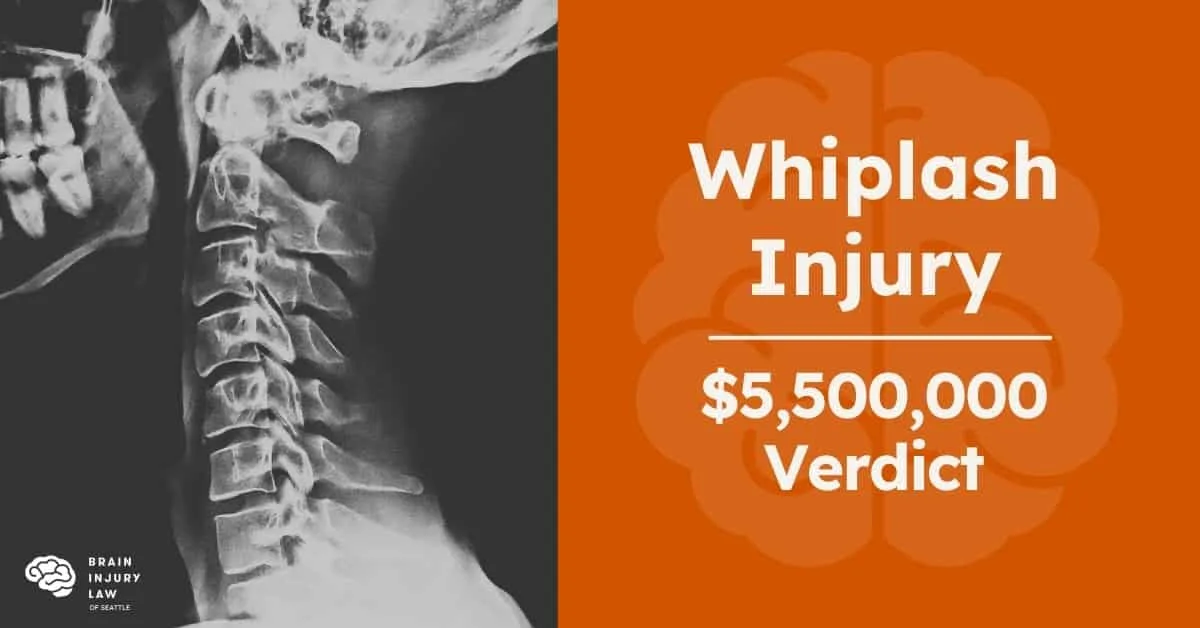
Proving the Neck Injury the Insurer Says Was Already There
Brain Injury Law of Seattle represents people across King County, Snohomish County, and Yakima whose necks were injured in crashes and falls. Insurers treat neck claims as routine, and that is the problem. A cervical sprain, a herniated disc, or an irritated nerve root can end your sleep, your range of motion, and the job you held a month ago, and none of it is visible to someone looking at you. When the damage reaches the cord, it becomes a spinal cord injury claim. Our Seattle personal injury team builds these cases on medical proof, not argument.
Why Washington Families Trust Brain Injury Law of Seattle
A neck injury can be easy to minimize and difficult to prove, especially when an insurer points to an old MRI, prior treatment, or degenerative changes. The right legal team must understand the medical record, identify what changed after the crash, and present the evidence in a clear, credible way.
- Focused experience: Founding attorney Scott Blair has focused on brain injury for 25 years and has tried more than 100 jury trials to verdict in a 42-year career.
- National standing: Scott Blair chairs the American Association for Justice Traumatic Brain Injury Litigation Group.
- Imaging that shows what is wrong: We are recognized for applying advanced neuroimaging to visualize and demonstrate brain damage.
- A medical network: We work with neurologists, rehabilitation specialists, sleep doctors, endocrinologists, and cognitive therapists.
- Care coordination: We help clients get the right treatment with the right people, not a settlement alone.
- We come to you: We can meet you at home when travel is hard, and se habla español.
- No cost to begin: Case evaluations are free, and you pay no attorney fees until we recover for you.
A serious neck injury is not defined by whether someone else can see it. We work to show what changed after the crash, what treatment and limitations remain, and why the compensation sought must account for the full effect on your work, family, and future.
The Concussion Hiding Behind a Neck Injury
The force that throws a head forward and back does not stop at the neck. Federal guidance explains that a concussion can follow a hit to the body that moves the head and brain quickly back and forth, with no blow to the head. The symptoms it describes include memory and concentration problems, irritability, and trouble sleeping. A claim documented as a neck strain can leave the more serious injury out of the record.
If you were told your scans looked normal and something still does not feel right, trust that instinct. That guidance also notes that a brain scan is not needed to spot a concussion. See our traumatic brain injury symptoms resource for helpful information.
How Washington Law Treats a Preexisting Neck Condition
Degenerative change in the cervical spine is common, and defense lawyers use that fact hard. Washington law answers it. In Bennett v. Messick, the Washington Supreme Court considered a latent condition that caused no pain, suffering, or disability by itself. Where that condition plus an injury brings on pain or disability by aggravating the preexisting condition and making it active, the injury, and not the dormant condition, is the proximate cause of the pain and disability. The party at fault is then held for the entire damage as the direct result of the accident.
The court applied the same rule in Harris v. Drake. When an accident lights up and makes active a preexisting condition that was dormant and asymptomatic immediately before the accident, the preexisting condition is not a proximate cause of the resulting damages.
Both decisions turn on the condition having been dormant before the event, and Harris frames that as asymptomatic immediately before the accident. Neither addresses a condition that was already causing symptoms, which is why the medical history has to be gathered early.
Who Pays When the At-Fault Driver Carries Minimum Limits
Under RCW 46.30.020, a Washington driver must carry a liability policy meeting the legal limits or satisfy the requirement another way the law allows. Those limits, set in RCW 46.29.090, are $25,000 for bodily injury to or death of one person in any one accident and, subject to that per-person limit, $50,000 where two or more people are hurt. A cervical fusion can pass that floor before anyone counts lost income or the future care described on our catastrophic injury page.
Underinsured motorist coverage is often where the real coverage sits. Under RCW 48.22.030, a Washington auto policy must include it unless the named insured or a spouse rejects all or part of it in writing. The requirement does not reach time spent on a motorcycle or motor-driven cycle, though a motorcycle policy can carry separate underinsured coverage. Finding every layer is ordinary work in a car accident claim.
Deadlines and Fault Rules in a Washington Neck Injury Claim
Washington requires most personal injury actions to be commenced within three years under RCW 4.16.080(2). Waiting costs you twice over. Neck claims are won on early, consistent medical records, and a treatment gap is an easy target for an adjuster.
Being partly at fault does not end the case. RCW 4.22.005 provides that contributory fault chargeable to the claimant diminishes the award proportionately but does not bar recovery. A few narrow statutory exceptions exist. One is intoxication. RCW 5.40.060 makes it a complete defense only on three findings. The injured person was under the influence of intoxicating liquor or any drug at the time of the occurrence, that condition was a proximate cause of the injury, and the trier of fact finds that person more than 50% at fault.
Schedule a Free Consultation With a Washington Neck Injury Lawyer
If the insurer is already saying the problem was there before, that is not the end of the conversation. Reach out for a free consultation by calling our office or using our contact page. You will not pay attorneys fees until we recover for you, and se habla español.
Frequently Asked Questions
How long do I have to bring a neck injury claim in Washington?
RCW 4.16.080(2) requires most personal injury actions to be commenced within three years. Other rules can change that timetable, including claims involving a government entity or an injured child, so have the deadline confirmed for your facts.
The insurer says my MRI shows arthritis, not an injury. Does that end my claim?
Not by itself. Where a preexisting condition was dormant and without symptoms immediately before the accident and the accident made it active, Bennett v. Messick and Harris v. Drake treat the accident as the proximate cause of the disability that follows.
What if the driver who hit me carried only the minimum insurance?
The floor under RCW 46.29.090 is $25,000 for bodily injury to one person, which a serious cervical injury can exhaust. Underinsured motorist coverage on your policy may reach further. Another household policy sometimes applies, though RCW 48.22.030 does not require that coverage while you are in a vehicle owned by or regularly available to the named insured or a family member and not insured under that policy.