
How do we prove your brain injury is true? Cutting edge technologies can provide us with incontrovertible evidence.
At Brain Injury Law of Seattle, we believe the best way forward is to objectively document a brain injury using the latest technology that is capable of showing the damage itself—damage that occurs on the microscopic level.
What Evidence Can Cutting Edge Technology Provide?
When a brain injury occurs as the result of a blow to the head or severely jarring motion such as a fall or car accident, some of your brain cells are pulled apart, which causes microscopic damage.
This damage can disrupt the electrical activity in the brain so that all of the areas of the brain are not functioning in harmony. It’s rather like a symphony where the horn section is playing in a different key than the string section, resulting in a confused sounding musical piece.
Scarring and inflammation then result at the cellular level, which cannot easily be seen on a normal MRI or CT scan, but there are more advanced diagnostic tests for TBI now available.
Advancements for the Accurate Assessment of Brain Injury
For decades, doctors had difficulty with the question of how to diagnose a brain injury, simply because they lacked the specific diagnostic tests for TBI. The imaging technology they really needed to accurately and precisely see what was happening beneath the skull and outer tissue of the patients’ brains had yet to be developed.
Luckily, that has changed. What is it doctors have learned about how to diagnose and confirm a brain injury?
One modern way to see these areas of brain damage is a traumatic brain injury assessment called ASL (arterial spin labeling). This is an enhanced MRI that uses a special technique to measure diminished blood flow in the areas of the brain where scarring and inflammation has occurred due to trauma.
Click on the image below to see for yourself how this MRI technique helps show the areas of brain injury in a person who was in a severe rear-end collision:
DTI Image
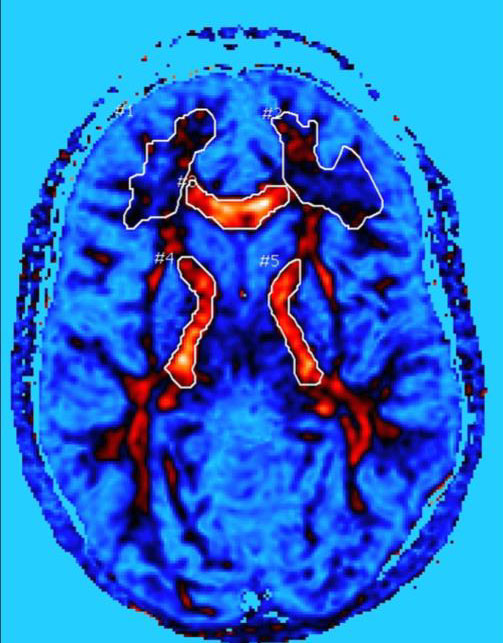
Another enhanced MRI technique we use for our clients is called Diffusion Tensor Imaging (DTI)—a highly reliable technique used to help measure white matter damage to the inner part of the brain.
While ASL measures grey matter damage on the outer part of the brain, DTI measures the deeper white matter damage that cannot be seen on normal MRI either. These are methods to objectify brain damage that the responsible party may claim does not exist.
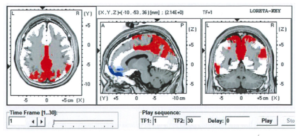
Another technique we use to objectify brain injury at Brain Injury Law is Quantitative Electroencephalography (QEEG) to map areas of the brain that show irregular electrical brain waves consistent with brain injury.
The Traumatic Brain Injury Lawsuit—Is a TBI Hard to Prove?
It used to be quite difficult. The usual defense argument was that most brain injuries resolve within 6 weeks, so any lasting damage could not have been the defendant’s responsibility. So, what is evidence of a traumatic brain injury in a head injury claim?
The best way to defeat that line of reasoning in a TBI case is to show, through objective evidence identified by cutting edge science, that your brain injury is in fact real.
Brain Injury Law of Seattle is one of a handful of law firms in the country that utilize these techniques to help our clients tangibly prove their case so they can get the medical treatment and compensation they need.
Related Article: How the Advancement of Traumatic Brain Injury Technology Can Help Your Case Injury Technology Can Help Your Case