For close to half a century, medical professionals used a simple scale to define traumatic brain injuries (TBI): the Glasgow Coma Scale (GCS). This scale has long been considered out of date, and experts have argued for years that it doesn’t properly capture the complexity of TBIs.
Thankfully, a new framework has finally been created by a coalition of neurologists, TBI researchers, TBI patients, and members of the National Institute for Neurological Disorders and Stroke (NINDS).
Called CBI-M (Clinical, Biomarkers, Imaging, Modifiers), this framework is a far more detailed and in-depth method of diagnosing TBIs. Your brain is the most complex organ in your body—the way injuries to your brain are classified should match that complexity.
Here’s what CBI-M stands for and how the new scale works.
What CBI-M Means and How It Works
The old scale had three basic categories for TBIs: mild, moderate, and severe. Categories like these just aren’t accurate enough by themselves to be truly useful, and they often keep patients from getting the care they actually need.
We’ve regularly worked with clients who were initially given a mild or moderate diagnosis, only to find later (through advanced imaging techniques) that their TBI was far more severe than they were told.
The new framework has 4 “pillars” that medical professionals can use to evaluate a TBI, resulting in a more accurate, more nuanced diagnosis:
- Clinical
- Biomarkers
- Imaging
- Modifiers
The 1st pillar (clinical) uses the old scale as a base and builds on it. GCS wasn’t necessarily wrong—it was just far too broad, and it failed to capture the complexity of brain injuries.
1. Clinical
The 1st pillar is heavily based on the Glasgow Coma Scale, using it as a starting point for TBI diagnosis. They still look at a wide range of factors—here are a few of them:
- Whether you became unconscious or not when you were injured
- Your pupils’ sensitivity to light and other stimuli
- Your reaction to verbal commands
- Whether you have memory gaps (amnesia) or not
- Whether you have headaches, dizzy spells, or are sensitive to noise
With the old scale, this is where you’d be diagnosed, and that would be the end of it.
You’d get your official diagnosis, and that would determine your level of care, the advice medical professionals would give you, and would even be used by insurance companies to decide how much they should pay for your injury.
The new CBI-M scale uses GCS as the 1st pillar and builds on it with the 3 new pillars.
2. Biomarkers
The 2nd pillar of CBI-M measures biomarkers in your blood. A biomarker is just something that can be measured in your blood. When your brain is injured, two proteins appear in your bloodstream in large amounts: GFAP and UCH-L1.
A blood test taken within 24 hours of your injury measures the level of these two proteins in your bloodstream. Low levels may indicate that your injury isn’t severe enough to require imaging.
3. Imaging
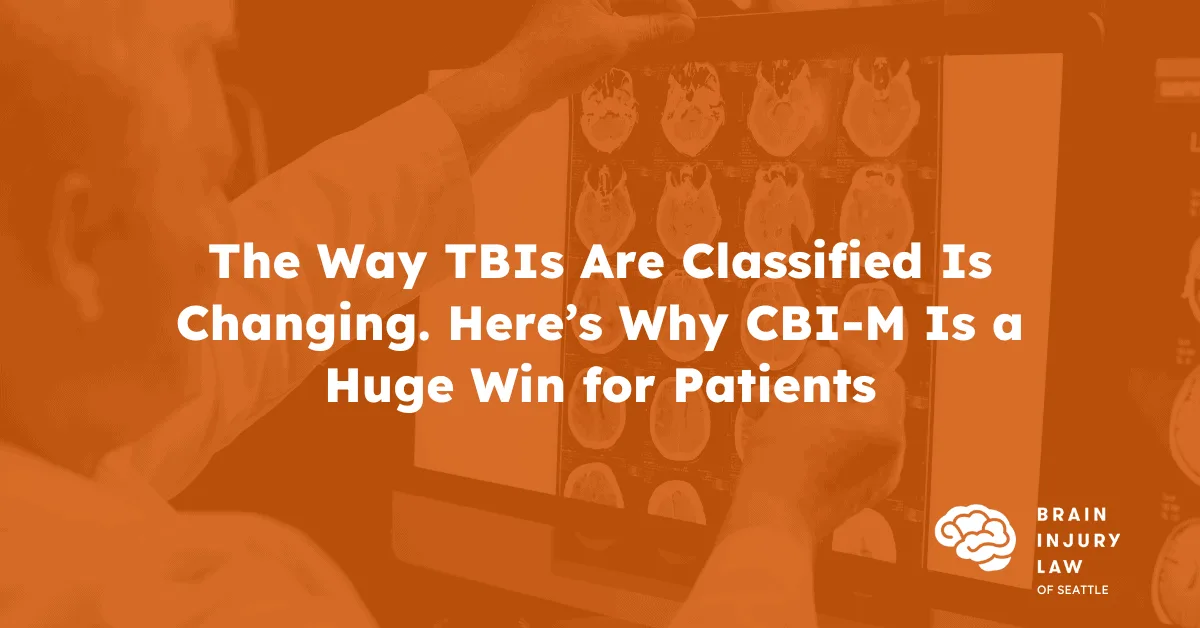
If clinical signs and biomarkers both indicate a severe injury, the 3rd pillar (imaging) is next. Your medical provider might order a traditional MRI or a CT scan.
They might also order Diffusion Tensor Imaging (DTI), which can show damage to the white matter in your brain, or Qualitative Electroencephalography (qEEG), which creates a “map” of your brain’s electrical activity (and shows where your brain isn’t functioning normally).
In many cases, only imaging and a blood test can show how severe a TBI truly is.
4. Modifiers
Finally, the 4th pillar looks at a number of factors that could either be causing your TBI symptoms or making them worse:
- How you were injured (a fall, a sharp object, a blow to the head, etc.)
- Other conditions you already have
- Medications you’re on
- Your access to healthcare
- The environment you live in
All of this adds up to a much more detailed diagnosis, which determines everything from what medications and therapies might be recommended to how much an insurance company will pay for your injury.
Why the CBI-M Framework Is Such a Huge Win for Patients
To say that CBI-M is earth-shattering still wouldn’t capture how massive of a change this is and how important it’s going to be for anyone suffering from a TBI.
The old Glasgow Coma Scale had numerous problems. One of the biggest issues was that it didn’t include the use of biomarkers.
Adding biomarkers is a game-changer: a simple blood test can show that imaging is necessary—possibly advanced imaging—leading to quicker diagnoses of serious TBIs that aren’t readily apparent from a simple clinical examination.
Instead of patients being told they don’t need an MRI, that their TBI is mild, and that they can go home, the standardization of blood tests will ensure more people who need advanced imaging and treatment get it right away—not weeks or months later as symptoms persist (and their injury gets worse).
We’ve had numerous clients who were told their TBI was mild, only to find later through specialized imaging techniques that their TBI was far more severe than they were initially told.
Sadly, many of those clients didn’t get the care they needed right away, leading to worsened injuries and permanent damage.
On top of that, insurance companies were unwilling to pay up, using the initial incorrect or incomplete diagnosis to try to prove that our clients weren’t hurt as badly as they were.
We’ve seen companies—both in the courtroom and at the negotiating table—point to that initial misdiagnosis over and over to get out of their obligation to pay. Getting that first diagnosis correct is critical.
It’s Not Just About the Money—Patients Are Going to Get Better Care Faster
This new method will result in more accurate diagnoses, which means insurance companies will be more willing to do the right thing from the beginning.
However, with widespread adoption, we’ll see something far more important happen: patients everywhere will have better outcomes after a head injury.
Those same clients of ours who were told they had “mild” TBIs didn’t get the urgent care they needed right away. Many of our clients have suffered permanent harm because of this, harm that could have been prevented if they were diagnosed properly.
This usually isn’t the fault of the medical professionals involved—they’re constrained by what insurance companies are willing to pay for and what medical institutions allow them to test.
The reason for this often has to do with the standards they follow—for TBIs, they only had the Glasgow Coma Scale.
A More Accurate, Widely Accepted Framework Means Better Outcomes for Our Clients—Both in the Hospital and in the Courtroom
Thanks to CBI-M, medical institutions and medical professionals have a more accurate evidence-based framework to justify tests and imaging that might have been a hard sell before.
Medical professionals can now point to CBI-M when pushing for specific tests or imaging for their patients, and medical insurance companies will be more likely to pay for these services.
Additionally, the kind of insurance companies we usually deal with (auto insurance providers, homeowners insurance providers, etc.) will be more likely to accept these tests and have less ammunition to use to try to deny claims.
Better outcomes for patients and better behavior from insurance companies? That’s a huge win for our clients and the medical professionals who treat them.
If You’ve Been Injured and Have a Brain Injury (or Suspect You Have One), We’re Here to Help
If you’ve been injured and have a brain injury—or even if you just suspect you have one as the result of an injury—we can help.
Click here to contact us today and schedule a free consultation. We’ll talk about your injury, the symptoms you’re struggling with, and how we can help.